If your building has poor indoor mobile coverage, a distributed antenna system (DAS) is usually the answer. The next question is which kind: active or passive. The choice affects cost, how far the system can reach, how many operators it can carry, and how easily it can grow.
This guide compares active and passive DAS side by side and explains when a hybrid design makes more sense.
What is a passive DAS?
A passive DAS distributes the mobile signal using only passive components: coaxial cable, splitters, couplers and antennas. Nothing in the distribution network needs power. The signal comes from a donor antenna and repeater, or from operator equipment on site, and is divided out to antennas across the building through passive splitters and couplers.
Strengths
- Lower equipment cost, especially in small and medium buildings
- Simple design with few active components to fail
- Works with most frequency bands, because passive components are largely band-agnostic within their rated range
Limitations
- Signal is lost along every metre of coaxial cable and at every split, so coverage drops over long runs and tall buildings
- Coaxial cable is thick and heavy, which makes long vertical risers harder to install
- Adding operators or bands later can mean redesigning large parts of the system
What is an active DAS?
An active DAS converts the radio signal at a central head-end into an optical signal. It is carried over fiber optic cable to powered remote units placed around the building or campus, which convert it back to radio for the local antennas.
Strengths
- Fiber carries the signal over long distances with very little loss, so performance stays consistent across large sites
- Well suited to multiple operators and multiple bands on one system
- Easier to expand: new remote units and zones can be added as the building grows
- Remote units can usually be monitored centrally, making faults quicker to find
Limitations
- Higher equipment cost
- Remote units need power and space, and often battery backup
- More complex design and commissioning
Active vs passive DAS at a glance
| Factor | Passive DAS | Active DAS |
|---|---|---|
| Distribution medium | Coaxial cable | Fiber optic cable to powered remote units |
| Typical building size | Small to medium | Large buildings and campuses |
| Signal loss over distance | High | Very low |
| Equipment cost | Lower | Higher |
| Power at remote points | Not needed | Needed |
| Multiple operators | Possible, harder to scale | Designed for it |
| Adding capacity or bands later | Often needs redesign | Usually modular |
| Monitoring | Limited | Typically centralised |
What about a hybrid DAS?
A hybrid DAS uses fiber and active remote units to carry the signal between floors or buildings, then passive coaxial distribution from each remote unit to the antennas on that floor. It reduces the long, lossy cable runs of a purely passive system while keeping equipment costs below a fully active one. For many mid-size and large buildings, hybrid is the practical sweet spot.
How to choose: the questions that decide it
- How big is the building, and how is it laid out? Long horizontal runs, many floors or several buildings on one site push towards active or hybrid.
- How many operators and bands must it carry? One or two operators in a small building can work well on passive. Several operators, plus future 5G bands, favour active.
- How many people use the space? Coverage and capacity are different problems. Busy venues such as stadiums, malls and transport hubs need a design that can add capacity, not just signal.
- What is the signal source? An off-air source from a roof antenna suits smaller systems. Larger systems are usually fed by operator base stations or small cells on site.
- Is public safety coverage required? Fire codes may require dedicated public safety radio coverage, which affects the design and equipment.
- What is the budget across the system’s life? A passive system may cost less to install but more to rework later if the building’s needs grow.
Our view
There is no single right answer. The best choice comes from a site survey and an RF design that models the building before installation. Specialist tools such as iBwave predict coverage for each option, so the decision rests on measured data rather than guesswork. Read more about in-building wireless design.
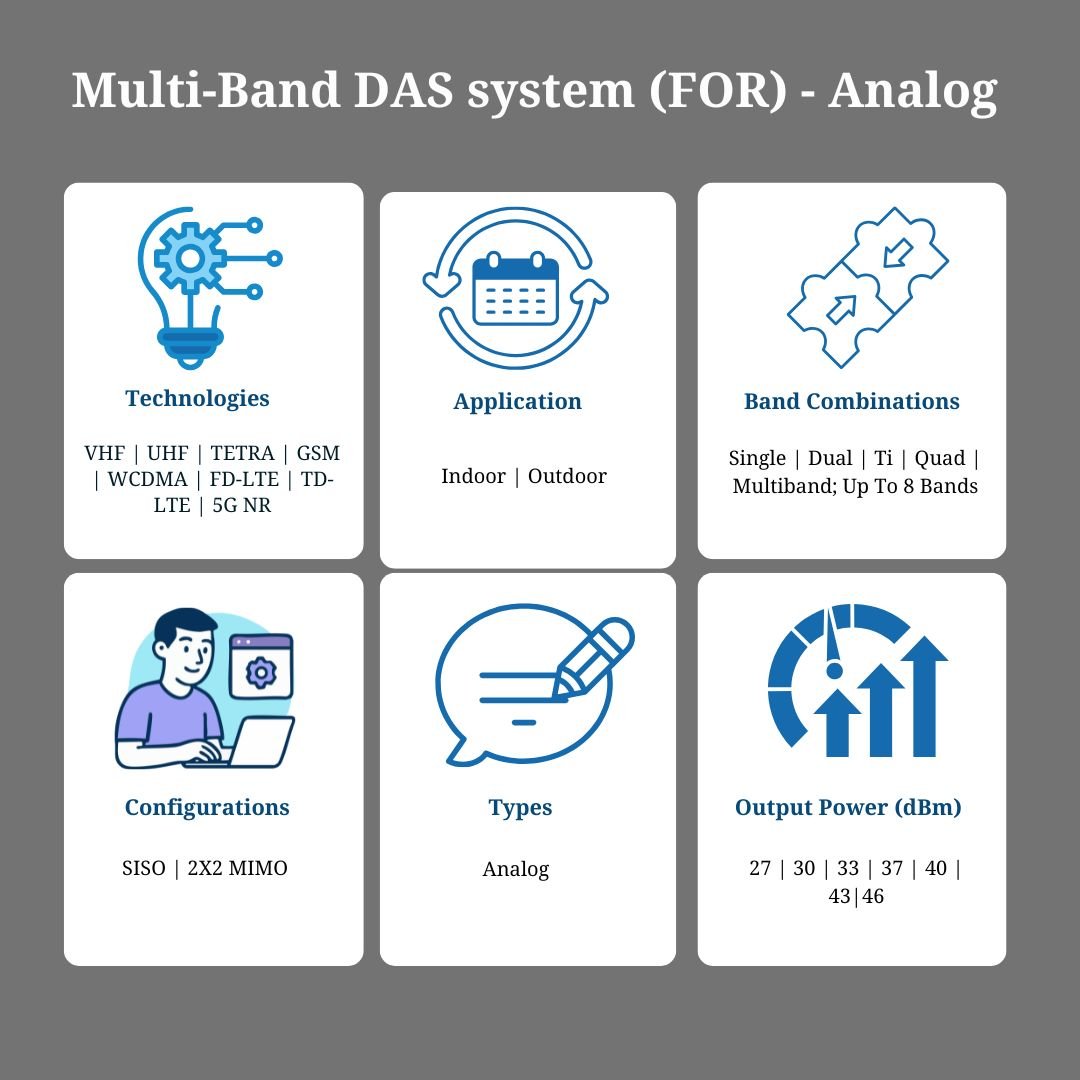
Aegotel supplies both analog and digital multi-band DAS equipment and designs passive, active and hybrid systems.
Frequently asked questions
Is active DAS better than passive DAS?
Not always. Active DAS performs better over large areas and with several operators, but passive DAS is often the more cost-effective choice for smaller buildings with simpler needs.
Can a passive DAS be upgraded to an active DAS?
Parts of it can. Antennas and some horizontal cabling may be reused in a hybrid upgrade, but the backbone usually changes from coaxial cable to fiber.
Does an active DAS need power on every floor?
Remote units in an active or hybrid DAS need power, and often battery backup, at each location where they are installed.
Which type is best for 5G?
Both can carry 5G if the components support the bands in use. Active and hybrid designs are usually easier to extend as new bands are added.
Get the right design first time
Choosing the wrong architecture is one of the most expensive mistakes in an in-building wireless project. Talk to Aegotel about a site survey and a design that fits your building today and as it grows.